
What we buy
Two lists, plainly written. What we want, what we usually pass on, and the reasoning behind both. Read it before you send photographs and you will know roughly where you stand.
The honest bit first
Condition decides. It always has.
The name on our lorries is We Buy Any Cabin, not a guarantee that we will take anything with four walls. Every buyer in this trade applies conditions. Most of them just wait until the lorry arrives to mention it.
We would rather set out the criteria in public. It saves you the effort of photographing something we were never going to buy, and it saves us sending a driver across three counties to look at a shell.
The good news is that the list of things we want is longer than the list of things we do not, and the bar is lower than people expect. Scruffy is fine. Old is fine. Ex-hire with somebody else's branding on the side is fine. We buy units that need work, because putting work into units is part of what we do.
Where we stop is safety, legality and arithmetic. If a unit cannot be lifted without risk, cannot legally be moved, or costs more to handle than it will ever be worth, buying it would be a favour dressed up as a transaction.
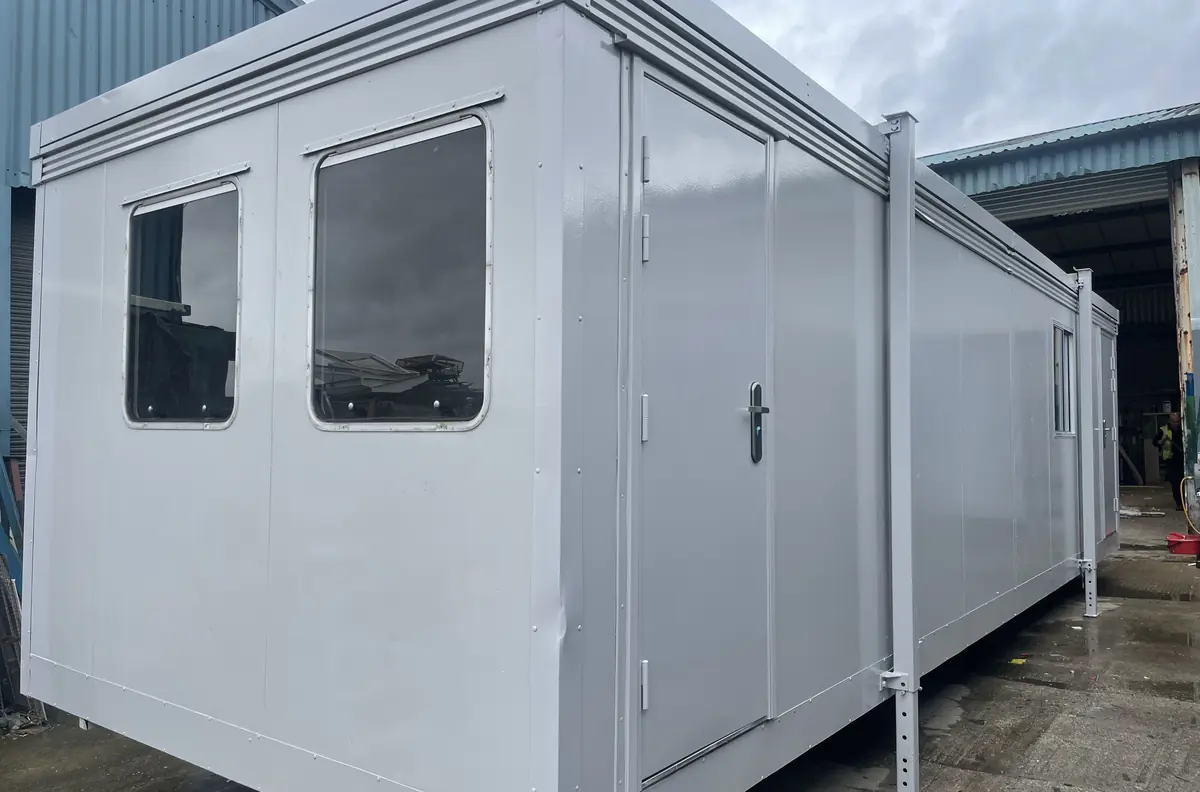
Yes
What we want to buy
If your unit sits in any of these, it is worth sending photographs.
- Structurally sound units of any age. A true frame, a solid floor and sound corner posts are the whole test. The year it was built matters far less than whether it has been kept dry and lifted carefully.
- Ex-hire fleet. Maintained on a schedule, consistent across a batch and generally straight, because hire companies cannot afford units that fail on site. Livery is not an obstacle.
- Tired but straight cabins. Faded, dented, grubby inside, floor covering shot, windows past their best. All of that is cosmetic and all of it is normal. This is the majority of what we buy.
- Steel anti-vandal units. Shuttered windows, steel doors, built to be knocked about. They survive better than lighter units and there is steady demand for them, so they are consistently worth buying.
- Welfare units. Canteen, drying room and WC combinations. Even where the fit-out is worn, the shell and the layout carry value. See used welfare units.
- Shipping containers, plain or converted. 8ft through 40ft. Rust and dents are cosmetic; doors and floor are what count. Detail on selling containers.
- Toilet and shower blocks. Provided the units are drained, the fittings are intact enough to assess and the block can be lifted. Worn sanitaryware is expected.
- Units with sound lifting points. Intact corner eyes or castings, not corroded through and not cut off. This is the one item on the list that is genuinely non-negotiable, because everything else depends on it.
- Single units and whole fleets. One cabin behind a house or forty coming off a depot. See sell my cabin or fleet disposals.
Usually not
What we normally pass on
None of these are said to be difficult. Each one is a real reason, and each one costs more to work around than the unit is worth.
- Severe fire damage. Heat weakens steel in ways you cannot see, especially at welds and lifting points, so the unit cannot be certified safe to lift. The residue is contaminated waste. It becomes a disposal job, not a purchase.
- Long-term water ingress with a rotten floor. Once the deck has gone soft the joists usually went first, and the damage is rarely limited to the area you can see. Replacing a floor is close to rebuilding the unit from the frame up.
- Stripped shells. Cabins with the windows, doors, cladding or wiring already removed have no resale route. Recovering them costs more than a complete second-hand unit, so all that is left is scrap value against transport cost.
- No safe lifting points. Corner eyes missing, cut off, or corroded through. There is no legitimate workaround. A lift that relies on improvisation risks the driver, the site and everyone standing nearby, so the answer is always no.
- Twisted or collapsed frames. A unit that has racked out of square, dropped a corner or been crushed cannot be lifted predictably. It also will not sit, seal or lock properly for whoever might buy it next.
- Units we cannot legally or safely move. Sealed inside a completed building, on the wrong side of a weight-restricted bridge, so heavy it needs an abnormal load permit that costs more than the cabin, or with a contamination history nobody can account for.
- Anything outside mainland Great Britain. We cover England, Scotland and Wales. We do not operate in Ireland or Northern Ireland, so we would only be arranging somebody else's transport, which is not what we are for.
Passed on does not mean stuck. Most of the units above can still be cleared from your site — see cabin disposal and cabin removal.
The grey area
Where it genuinely depends
Water damage caught early
A leak that has stained a ceiling tile is nothing. The same leak left for three winters is a floor replacement. Photographs of the floor near the door usually settle which of the two you have.
Badly cut conversions
A container or cabin with openings cut in without proper framing has lost strength. Sometimes it is repairable and worth buying, sometimes it is a shell with holes. We need to see how the work was done.
Access we cannot reach
A perfectly good cabin behind a building with no crane access is a problem of geometry, not condition. There are answers, but they change the arithmetic, so tell us early.
Vandalised units
Smashed windows and graffiti are cosmetic. Stripped copper, cut cabling and a fire lit inside are not. The difference is whether the structure was touched.
Very small or unusual units
Odd sizes and one-off builds have a thinner market. We do buy them, but they take longer to place, and that shows up in the figure rather than in a refusal.
Units that have never moved
A cabin that has sat on soft ground for a decade may have rotted at the bearers even though the body looks fine. Worth checking underneath before you decide it is straightforward.
If you are unsure which side of the line yours falls, send the photographs anyway. An honest answer costs you nothing and takes us a few minutes. What affects the value.
Questions about what we will and will not take
Does the name mean you buy anything at all?
No. We Buy Any Cabin is a name, in the same way that a shop called The Bargain Basement is not promising to be underground. We buy a wide range of units in a wide range of condition, including plenty that other buyers walk away from. We do not buy units that are unsafe to lift, illegal to move or worthless once collected.
Why does severe fire damage stop you buying a cabin?
Fire does two things. It destroys the fabric you can see, and it weakens steel you cannot assess by eye, particularly around welds and lifting points. A burnt-out unit also carries contaminated debris that has to be handled as waste. Both make it a disposal job rather than a purchase, so the money moves the other way.
What is wrong with a cabin that has no lifting points?
Everything about how we collect it. Corner lifting eyes are where the load goes when a crane picks the unit up, and there is no safe improvisation if they are missing, cut off or rotten through. Dragging a cabin onto a lorry with straps and hope is how people get hurt, so we will not do it.
My cabin is tired but sound. Is it worth sending photographs?
Almost certainly. Tired but straight is the single most common thing we buy. Faded cladding, scruffy interiors, a floor that needs a covering and windows that need attention are all ordinary. What we care about is whether the frame is true, the floor is solid underfoot and the unit will lift safely.
If you will not buy it, can you still take it away?
Usually. A unit we will not purchase can often still be removed and disposed of responsibly, with steel recycled and the rest handled properly. That is a chargeable job rather than a sale, and we will tell you which of the two you are looking at before anyone commits to a date.
Not sure which list yours belongs on?
Send photographs of the outside, the inside, the roof and the corners. We will tell you plainly whether we are buying it, clearing it, or neither.