
Cabin removal
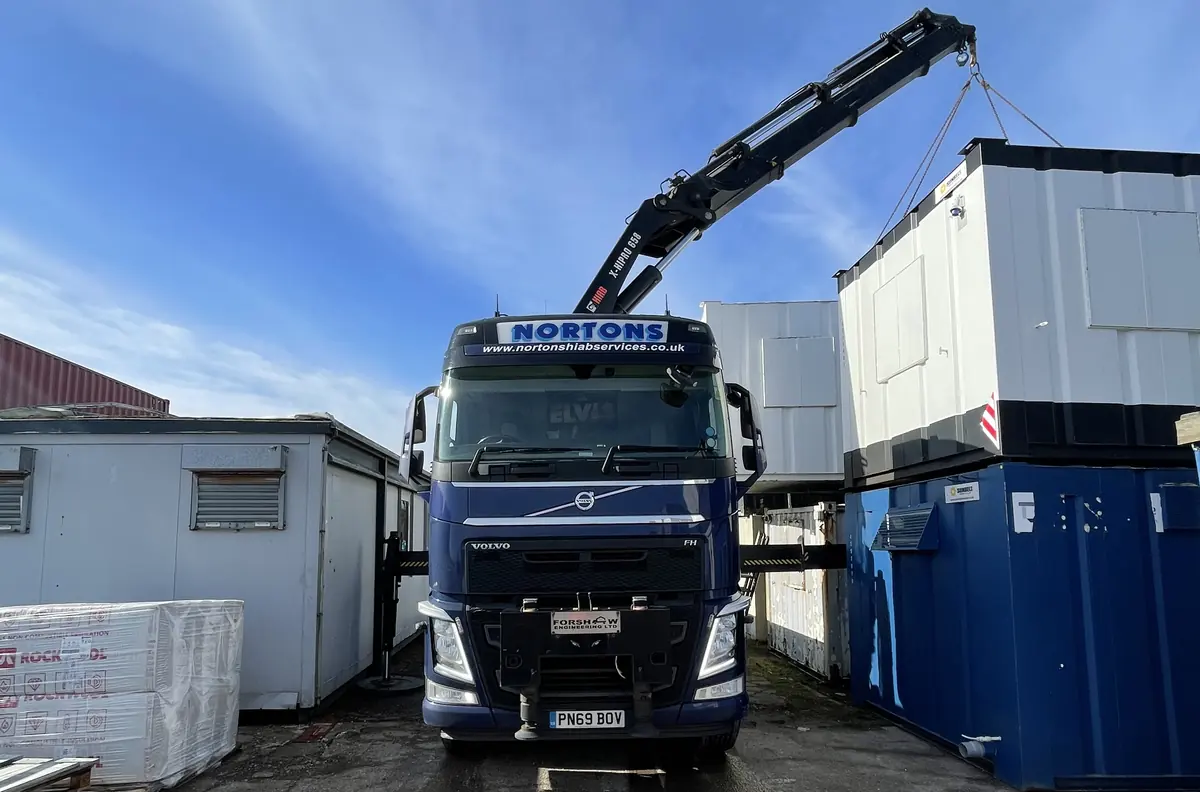
Getting a unit off its base and off your site — whether we are buying it or not. Our own Hiab lorries, our own drivers, and a date we can hold to.
The job
Removal is a job in its own right
Most people find this page because a cabin is in the way. The contract has finished, the yard is being sold, the unit has sat behind a workshop for nine years and nobody has been in it since. What happens next depends almost entirely on the condition of the unit and the access to it.
Where a cabin still has resale value, we buy it and the removal comes out of what we pay you. Where it does not — soft floor, failed roof, gutted inside — the removal becomes a chargeable job and the unit goes for disposal. We do not buy any cabin regardless of condition, and saying otherwise would only waste a visit.
Either way the physical work is the same: assess the lift, get the lorry to it, take it away. What changes is which direction the money goes.
Before we quote
What we need to know first
Six things decide whether a removal is straightforward, awkward or impossible. Answer them up front and the quote you get is the price you pay.
| What we ask | Why it matters | What helps |
|---|---|---|
| Access route | An artic and a Hiab need width, height and a turning circle. Bollards, height barriers, tight gateposts and soft verges all change the vehicle we send — or rule the job out. | Photographs taken from the road looking in, not just of the cabin |
| Ground conditions | The outriggers put the whole weight of the lorry and load through four small pads. Tarmac and concrete are fine. Wet clay, gravel over made ground and unsupported drain covers are not. | Tell us what the surface is and whether it holds up in rain |
| Overhead obstructions | The crane lifts upwards before it swings. Power lines, telephone cables, tree canopy, canopies over loading bays and low warehouse eaves are the most common reason a lift is abandoned on site. | Look up and photograph what is above the unit |
| Position of the unit | Reach falls away with distance. A cabin sitting eight metres from where the lorry can park is a very different job from one sitting two metres away, even on the same yard. | Rough distance from the nearest hard standing the lorry can reach |
| Services | Live power, plumbed water, a soil connection or a data cable all have to be dealt with before anything moves. | Confirm what is connected and who is disconnecting it |
| Contents and fixings | Loose contents shift in transit. Units bolted to a base, welded to steels or joined to a neighbouring cabin need releasing first. | Say whether it is empty and how it is fixed down |
If you are not sure about any of it, send photographs and we will tell you what we are looking at. Guessing at access is how a wasted lorry journey happens, and that helps nobody.
On the day
How a removal actually runs
How long we are on site depends on the unit, the ground and the access, so we would rather book the time properly than promise a slot and rush the lift.
-
The driver walks the job before anything moves
Route in, ground under the outriggers, what is overhead, where the unit will be set down on the trailer. If something has changed since you sent the photographs, this is when we find out.
-
Lorry positioned and outriggers set
Legs out onto pads, machine levelled. On block paving, thin tarmac or anything soft we spread the load further. This is the stage that protects your surface as much as our lorry.
-
Unit checked and rigged
Chains or strops to the four corner lifting points. The driver checks the eyes are sound and that the cabin is not still fixed to its base, its neighbour or a service.
-
The lift
Lifted clear, swung over and set down on the trailer. Anybody not involved stands well away from the arc — that includes you, however much you want to watch it.
-
Strapped and sheeted
Secured for the road. Doors and shutters fastened, loose panels dealt with. Nothing leaves the site until it is safe to travel.
-
Base left as we found it
We take the cabin. We do not take away the sleepers, hardcore or slab underneath unless that is part of what was agreed — so tell us in advance if you want the base gone too.
Responsibilities
Who does what
Yours, before we arrive
- Electrical supply isolated and disconnected by a competent person
- Water supply capped and waste connections broken
- Unit emptied of contents, furniture and anything loose
- Any bolts, welds or ties to the base or to neighbouring units released
- Vehicles moved and the access route clear on the day
- Site permits, inductions or gate access arranged if we need them
Ours, on the day
- The lift plan, the lorry, the crane and the driver
- Assessing ground bearing and spreading the outrigger load
- Rigging, lifting, loading, strapping and sheeting
- Transport to our yard, to a buyer, or to disposal
- Onward handling of the unit once it leaves you
- Waste carrier details on request where the unit is being scrapped
Disconnection is the one that trips people up. We are hauliers and cabin dealers, not electricians, and we will not pull a live supply. Book your sparks for the day before, not the same morning.
Scale
One unit, or the whole compound
A single cabin
The most common call we get. One unit behind a workshop, on a farm, or at the back of a yard. Straightforward if the lorry can reach it, and often worth money to you if the shell is sound.
A handful of units
Two to six cabins coming off a job. Worth planning as one visit rather than several — the transport cost per unit drops sharply once the lorry is already there.
A full compound
Offices, welfare, drying rooms, stores, toilet blocks and containers, often stacked or linked. We plan the order so the last unit out still has a route to the gate.
Mixed condition
Compounds rarely clear cleanly. Some units we buy, some we take for disposal at a cost. We price them separately so you can see exactly what is happening to each one.
Stacked or linked units
Double-stacked cabins and linked office suites come apart in a particular order. Tell us the arrangement early — it affects the vehicle, the time and the number of visits.
Site clearance
Where the cabins are only part of it, we can take containers and units in the same programme. Loose site waste and demolition arisings are a different trade and we will say so.
How the Hiab collection works · What we buy and what we do not
Cabin removal questions
How much does portable cabin removal cost?
There is no standard figure, and anybody quoting one down the phone for a site they have not seen is guessing. What decides it is the distance from Manchester, where the lorry can stand, how awkward the lift is, and whether there is one unit or several in the same place. Send photographs from the approach looking in, a postcode and a rough size and we will put a number to it. If the unit has resale value that comes off the figure, and it can go the other way entirely.
Do you charge for removal, or do you pay me?
It depends entirely on the unit. If it has resale value we buy it and the removal is built into what we pay you. If it is finished — rotten floor, failed roof, stripped inside — then removal and disposal is a chargeable job, because somebody has to pay for the transport and the waste. Photographs tell us which side of that line you are on.
Who disconnects the electrics and water?
You do, before we arrive. Our drivers lift and haul; they do not isolate supplies. The unit needs to be dead, unplugged or unwired at the supply end, and any water and waste connections capped or broken. If the cabin is still live when we turn up, the lift does not happen and you have paid for a wasted journey.
Can you remove a cabin from a domestic garden?
Sometimes, and access is the whole question. The lorry needs to get within reach of the unit, and the crane arm cannot pass through a house. Rear gardens with no side access or a narrow ginnel are usually a no unless there is a neighbouring plot or road we can lift over. Send photographs of the approach as well as the cabin.
What if the cabin has been vandalised or burnt out?
We still look at it. A burnt-out shell is a disposal job rather than a purchase, and the price reflects the extra care needed loading something structurally compromised. Tell us honestly what state it is in — a unit that collapses on the lift is a bigger problem for everyone than one we knew about in advance.
How much notice do you need?
Give us as much as you can, particularly for anything with a tight window or a road closure. Because we run our own lorries rather than booking a haulier, we can commit to a date once we have quoted, instead of giving you an estimate that moves. Short-notice jobs come up and we will tell you straight if we can fit one in.
Can you clear several units in one visit?
Usually yes, and it is nearly always cheaper per unit than doing them one at a time. How many go on a load depends on the sizes and the weights. For a full compound we will plan the order of removal so the last unit out still has a route to the gate, which is the thing that catches people out.
Need a cabin gone?
Send photographs of the unit and of the access, tell us the postcode, and we will come back with either a price to buy it or a price to take it away.