
Used shipping containers for sale
Storage containers in 10ft, 20ft, 24ft, 32ft and 40ft, plus conversions. Delivered and placed by our own Hiab, including into spaces a trailer cannot reach.
Second hand shipping containers and used steel storage, from 8ft up to 40ft, including office and cabin conversions. We buy unwanted stock in as well, singly or by the yard-full.
Buying sensibly
Condition grades, and which one you actually need
Container grading is looser than people expect and the terms vary between sellers, so it pays to talk about the specific unit rather than the label. What matters in practice is a short list: do the doors open and close properly, is the floor sound, is the roof free of holes, and will it lift without complaint.
For most storage uses, a solid used unit in cosmetic disarray is the right buy. Paying a premium for straight panels and factory paint makes sense if it will be visible to customers, and very little sense if it is going behind a hedge to hold tools.
The exception is anything being converted later. If you plan to cut openings in it, start with a straighter shell — corrections cost more than the saving.
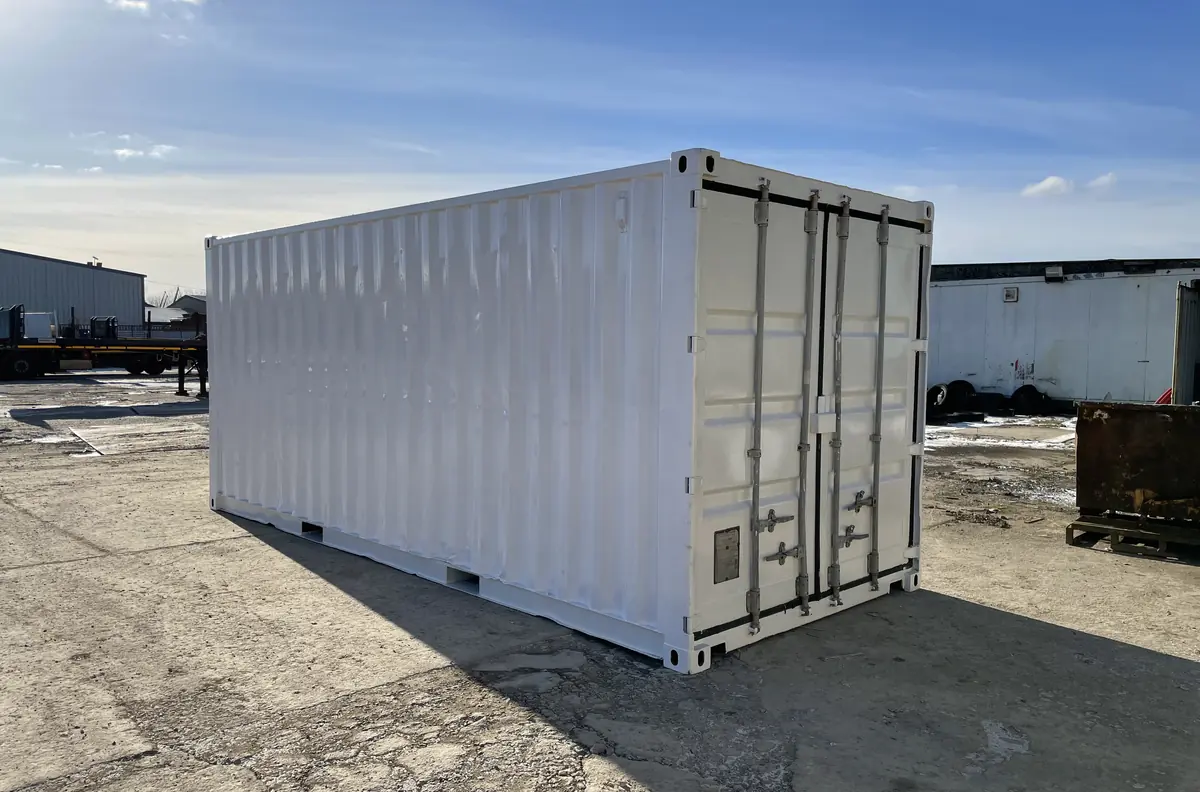
Sizes
The sizes that come up
| Size | External footprint | Typical use |
|---|---|---|
| 8ft | Approx. 8ft × 7ft | Small yard store, domestic use, tight spaces |
| 10ft | Approx. 10ft × 8ft | Tool store, site security store |
| 20ft | Approx. 20ft × 8ft | The default. Plant, materials, general storage |
| 24ft | Approx. 24ft × 8ft | Shortened 40ft. Where a 20ft is not quite enough |
| 32ft | Approx. 32ft × 8ft | Shortened 40ft. Where a 40ft will not fit but a 20ft is too small |
| 40ft | Approx. 40ft × 8ft | Bulk storage, workshop conversions. Needs real access |
| High cube | As above, roughly 1ft taller | Where internal height matters — racking, tall plant |
A 40ft is not simply two 20ft ones as far as access is concerned. The lorry, the turning circle and the lift are all a different proposition. Where access is uncertain, two 20ft units are often the practical answer.
Inspection
What we look at, and what you should
Doors first
Always. Open them, close them, throw the levers. Doors that need shouldering are a sign the shell has twisted, and that is not economically fixable.
The floor
Marine ply, and it takes the punishment. Soft patches, delamination and previous repairs all matter if you are putting weight or a pallet truck on it.
Roof from above
Ponding and pinholes. Water sitting on the roof finds its way through eventually and ruins whatever is underneath.
Corner castings
These take the whole weight in a lift. Damaged or distorted castings are a safety issue, not a cosmetic one.
Seals
Perished door seals are cheap to replace and the most common reason one that looks fine is damp inside.
Previous repairs
Plated patches are normal and usually fine. What matters is whether they were welded properly or tacked on and painted over.
No catalogue — a conversation
Tell us what you are looking for
Used stock turns over too fast for a price list to be honest for long. Give us the shape of what you need and we will tell you what we can put our hands on, what condition it is in and what it costs, with the transport priced separately.
If you have a unit to trade in against it, tick the box — part exchange usually improves the number in both directions.
- We will say if we cannot source it, rather than string you along
- Cabin and transport priced separately, so you can see both figures
- Refurbishment to your spec is usually possible before delivery
Questions about used containers
What does wind and watertight actually mean?
That the container keeps weather out: no holes, sound roof, door seals intact and the doors closing properly. It does not mean it looks new. A wind and watertight unit can be dented, rusty in patches and thoroughly scruffy while still doing its job perfectly well.
What is the difference between a one-trip and a used container?
A one-trip container has made a single voyage from the factory, so it is effectively new and priced accordingly. A used one has been in service for years. For storage on a yard or site, a sound used example usually makes far more sense than paying for cosmetics.
What ground does a container need?
Firm and reasonably level, with something solid under the four corner castings — concrete, paving slabs or railway sleepers. The corners carry the entire load. Placed straight onto soft ground it will twist as it settles, and a twisted shell has doors that will not close.
Can you deliver and place it in a tight space?
Often, yes, and this is where the Hiab earns its keep. Because the crane is on the lorry, we can lift over a wall or into a yard the trailer itself cannot enter, within the limits of the reach. Send a photograph of the access and we will tell you honestly whether it works.
Are converted containers worth buying used?
They can be very good value, particularly office and welfare conversions. Check the insulation and the electrical installation carefully, and look at how the openings were cut and framed. A poorly framed door or window opening weakens the shell and shows up as a shell that racks when lifted.
Do you buy containers as well as sell them?
Yes. Containers are usually simpler for us than cabins because they lift predictably and stack. Single units or a yard full of them. Our selling page sets out what we look at.
Containers sitting in the yard doing nothing?
We buy containers in any quantity, wind and watertight or damaged. Tell us the sizes, roughly what state they are in, and where they are standing.