
Hiab collection
One vehicle that lifts the cabin and then carries it away. We own the fleet and employ the drivers, which is the whole reason we can commit to a collection date.
The vehicle
A crane and a lorry in the same job
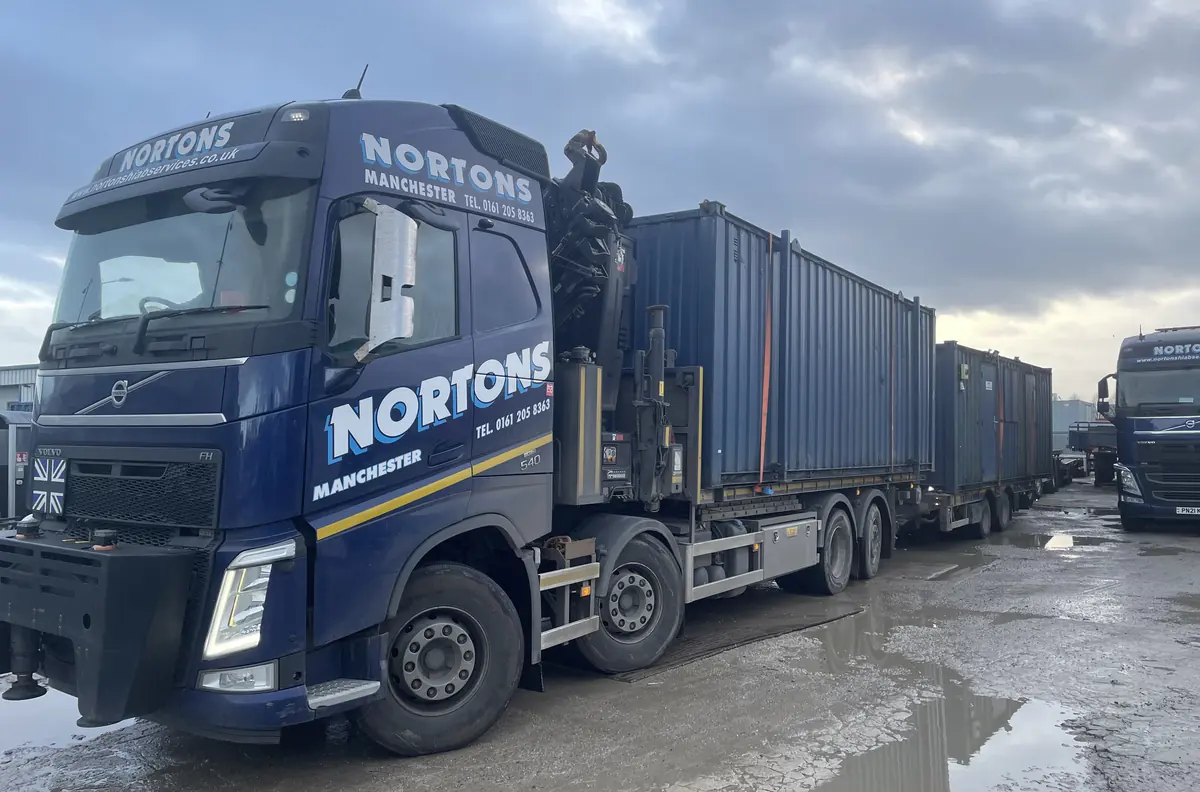
A Hiab is a lorry with a hydraulic crane mounted behind the cab. It folds down for the road and unfolds on site to lift the load onto its own bed. For portable cabins that combination is the point: a mobile crane plus a separate flatbed means two vehicles, two bookings and two sets of standing time, and one of them is always late.
The lift itself is made from the four corner points. Cabins have lifting eyes at the top corners; containers have castings. Chains or strops go on, the driver takes the weight, checks the unit is free and level, and lifts. Nothing is slung under the floor and nothing is lifted from the middle — a cabin picked up anywhere other than its corners will simply fold.
That is why the state of the corner posts and eyes matters so much when we look at photographs. A sound-looking cabin with torn lifting eyes is a much harder unit to move than a tired one with good corners.
Physics, not preference
The three things that decide whether a lift happens
Everything else on a collection is arrangeable. These three are not, and no amount of goodwill on the day changes them.
Reach
A crane's capacity drops as the arm extends. The load chart is fixed by the machine, not by how much anyone wants the job to work. A cabin the lorry can park alongside is straightforward; the same cabin across a verge and a hedge may be out of range even though you can see it.
Ground bearing
With the outriggers down, the whole weight of lorry, crane and cabin goes through four pads. Concrete and structural tarmac take it. Soft ground, made ground, sand-bedded block paving and anything above a drain, culvert or basement do not without spreading the load.
Headroom
The unit goes up before it goes across. Overhead power and telephone lines, tree canopy, warehouse eaves, loading bay canopies, gantries and height barriers all remove that space. This is the single most common reason a driver stands a job down on arrival.
Access
What the lorry needs to get in and work
Send photographs of the approach, not just the cabin. The unit is rarely the problem; the last forty metres usually is.
| Consideration | What to check | Common problem |
|---|---|---|
| Width | Gateways, gate posts, bollards, parked vehicles and the narrowest point of the route | A gate wide enough for a transit that nobody has measured for a lorry |
| Height | Height barriers, archways, low branches, canopies and building overhangs on the way in | Car park height barriers that cannot be unlocked on the day |
| Turning and reversing | Whether the lorry can turn on site or must reverse in and out of a live road | Dead-end yards with nowhere to swing the trailer round |
| Overhead cables | What runs above the unit and above where the lorry will stand | Service drops to a building that sit directly over the cabin |
| Standing surface | Surface type, drainage covers, recent excavation, and how it behaves in rain | Gravel over soft ground that looked fine in July |
| Working space | Room for the outriggers to extend fully on both sides of the vehicle | Outriggers that cannot be deployed because of a wall or parked cars |
| Distance to the unit | Metres from where the lorry can realistically stand to the cabin itself | Cabins tucked behind other units at the far end of a compound |
A quick video walked from the road to the cabin, phone held up as well as level, answers most of this table in twenty seconds.
Our fleet
Why we do not subcontract the haulage
Plenty of firms that buy cabins ring round for a lorry after they have agreed the deal. That works until it does not: the haulier's day changes, your slot moves, and the firm you actually dealt with is left telling you they are waiting to hear back.
We run our own Hiab lorries and employ the drivers. When we say a unit is being collected on Thursday, the Thursday belongs to us. If your site has a single window because of a road closure, a crane over-sail agreement or a handover date, that is exactly the situation where owning the transport stops being a talking point and starts mattering.
It also means the assessment is honest. The person judging whether the lift works is the person who will be standing there doing it, so there is no incentive to be optimistic about your access in order to win the job.
- A collection date we control rather than one we are waiting on
- The same firm assesses the lift, does the lift and buys the unit
- Multi-unit clearances run over consecutive days rather than whenever a lorry is free
- Straight answers about access before anyone commits
Have this ready for the day
- Power isolated and disconnected by a competent person
- Water off, waste connections broken and capped
- Unit emptied — furniture, files, tools, gas bottles, anything loose
- Keys for the cabin, and for any gates, barriers or bollards
- Bolts, ties and welds to the base or neighbouring units released
- Vehicles moved off the access route and the standing area kept clear
- Site induction, permit or gate contact arranged if we need one
- Somebody contactable on site, or clear instructions if it is unattended
What stops a lift on arrival
- The supply still live
- Cars parked where the outriggers go
- A cable over the unit nobody mentioned
- The cabin still bolted to its base
- Ground that has turned to mud since the photographs
Questions about Hiab collection
What actually is a Hiab?
A lorry-mounted crane. The name comes from the manufacturer and has become the trade word for the whole type, the way people say hoover. The crane sits behind the cab on a flatbed lorry, folds away for the road and unfolds to lift the load onto the bed. One vehicle does the lifting and the hauling, which is why it suits cabins.
Why does it matter that you own the lorries?
Because a subcontracted haulier fits you around their own diary, and the first you hear of a change is on the morning. When the lorry and the driver belong to the firm quoting the job, the date we give you is a date we control. It also means the person assessing the lift is the person who has to do it.
How close does the lorry need to get to the cabin?
As close as the site allows, and closer is always better. Crane capacity falls away the further the arm extends, so a unit two metres from the hardstanding is a much easier lift than the same unit eight metres away. If the lorry cannot get within reach at all, no amount of planning fixes it and we would need another approach.
What if my ground is soft or block paved?
Tell us in advance. The outriggers concentrate the weight of the lorry and the load through four small pads, so we spread the load with mats or pads where the surface needs it. Wet clay, gravel over made ground, unsupported drain covers and thin block paving over sand are the usual problems.
Can you lift over a wall or hedge?
Often, yes. The load has to travel through an arc the driver can see and control, and the crane must have the reach and capacity at that radius. We do not lift over buildings. Send photographs taken from where you would expect the lorry to stand and we will tell you honestly whether it works.
What if the cabin has no lifting points?
Then it becomes a different job. Most cabins and containers lift from corner castings or corner eyes, and those need to be sound. Where the eyes are corroded, torn or absent, we look at forked lifting, a low loader with a suitable machine, or in some cases we conclude the unit is only fit for breaking on site.
Book a collection with a date attached
Send photographs of the unit and the access, tell us the postcode, and we will confirm the lift and a day we can hold to. Buying, removing or disposing — same enquiry.