
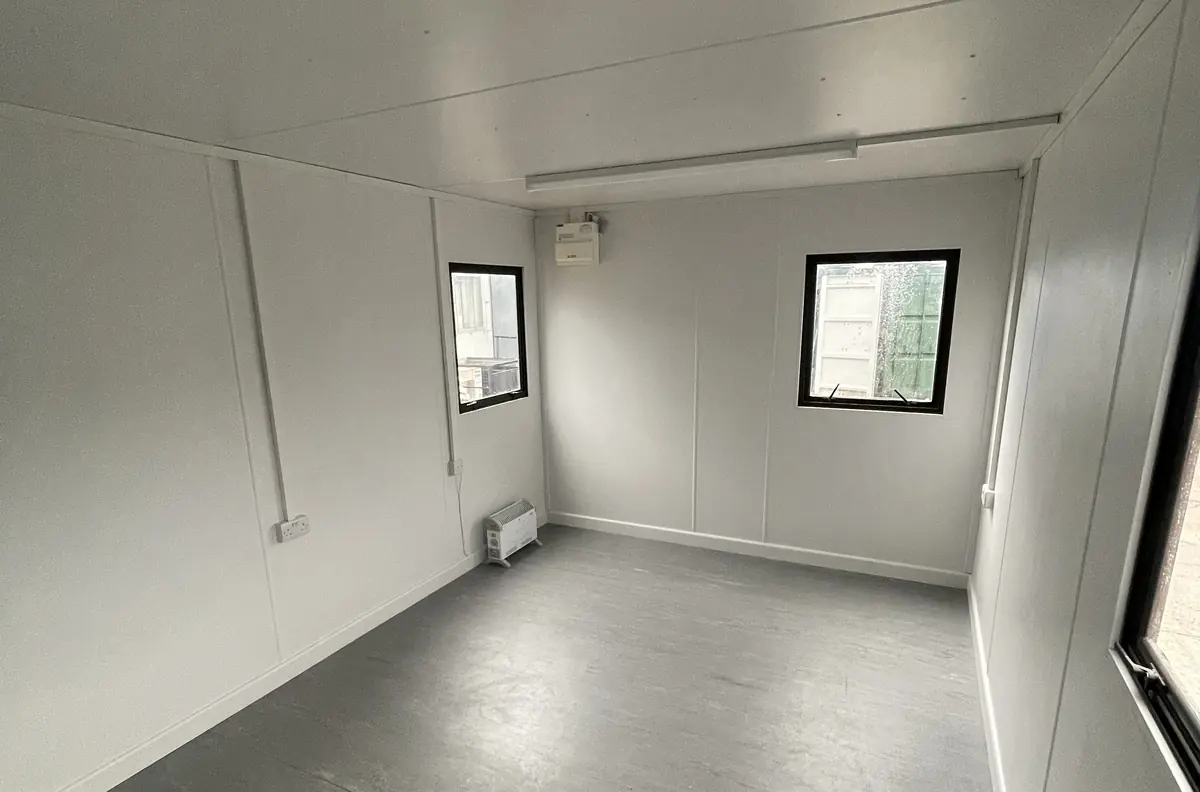
Where the water on the glass comes from
By the middle of November a cabin that behaved itself all summer starts running with water down the inside of the windows, and somebody decides the roof has gone. Usually it has not. The water came in through the door, in the air, on your coat.
Warm air carries moisture. Cold air carries far less of it. Put six people in a 20ft office with a kettle going, wet jackets over the backs of the chairs and boots that have been in a trench since seven, and the air in that room is loaded. When it touches a cold surface it lets go of what it can no longer hold. The glass goes first, because the glass is the coldest thing in the room. Then the window frames, then the corners of the ceiling, then the patch of wall behind the cupboard nobody has moved since April.
Once you look at it that way the fix stops being a mystery. Either put less water into the air or get the wet air out before it lands on something cold. In practice you do both, and neither costs anything.
Ventilation beats sealing it up
The instinct in cold weather is to shut the place down. Vents taped over because somebody felt a draught. The window that has not opened since the handle stiffened up two winters back. A bit of board wedged across the grille in the door. Then the heater goes on full and by ten o'clock the cabin is warm, wet and smells like a drying room.
Leave the vents alone. They are there to let moisture out, and the heat they cost you is small against what damp air costs you in comfort and in the condition of the unit. If there is an opening window, open it properly for a few minutes at the start and end of the day, even in January. Short and sharp works better than a window on the latch all day, because you swap the air without pulling the warmth out of everything solid in the room.
Then cut down what you are putting in. Dry the coats somewhere other than the office if there is anywhere else to put them. Keep the mop and the wet floor in the welfare unit rather than the room where people sit still all day. If the site has a separate welfare unit, use it for the wet jobs and let the office stay dry.
Heating, and what the wiring gives you
Our cabins are wired to 240V with lighting, sockets and usually a heater. Heating only. There is nothing in a unit like this that cools the air, and it is worth knowing that before you plan around it.
What matters in winter is steady heat rather than heroic heat. A cabin blasted for two hours in the morning and then left to go cold swings past the point where moisture drops out of the air twice a day, and every swing puts water back on a cold surface. A low background heat across the working day does more for damp than a fan heater roaring at eight and nothing after four.
What it should not turn into is four heaters daisy-chained off one extension lead because the cabin feels cold. If the unit came from us the electrics have been tested and certified and the paperwork came with it, but that paperwork describes what was in the unit when it left our yard, not whatever has been hung off it since. Anything added afterwards wants somebody competent doing it.
How well a cabin holds heat depends on the cabin
We are not going to tell you our units are warm as a general statement, because it would not be true of all of them. Insulation on a portable unit depends on how old it is and how it was specified when it was built. A cabin put together as a long-stay office and a cabin put together as a lock-up can sit side by side in the same yard and behave completely differently in February.
So ask about the specific unit. When you ring about something on the cabins we have for sale we will describe what is actually there rather than what would sell it. If holding heat matters — an office where people sit still all day rather than a store you walk into twice a shift — say so at the start of the conversation and we will tell you whether the unit in front of us suits that or not. Sometimes the honest answer is that it does not.
Check the floor by the door in February
Winter is when a cabin shows you its weak spots, and the floor at the threshold is the first one. That is where boots put water down every hour of every wet day, where grit gets ground in, and where the seal usually gives up first. Walk the length of the unit with your weight through your heels. Anything soft, anything that gives, anything that sounds different underfoot has had water in it.
Do the same under each window. A frame that weeps quietly all winter wets the boards below it long before a stain appears on the surface. Caught in February, damp boards and linings are a repair. Left until the following autumn they are a reason the unit is worth a good deal less.
While you are outside, look at the roof edge and see whether water is sitting up there rather than running off, and look at the ground around the unit to check it drains away from the cabin rather than under it. A unit standing in a puddle all winter is a unit with a wet floor by spring.
A short list for the back end of October
- Clear anything sitting on the roof and check water runs off the edge rather than pooling.
- Take the tape, board or cardboard off any vent somebody covered in a cold snap last year.
- Free off the opening windows now, while it is still mild enough to want them open.
- Check the door seals and that the door still shuts properly on its own weight.
- Look at where the ground water goes when it rains hard, and dig it a way out from under the unit.
- Put a decent mat inside and outside the door and empty the office of anything wet.
- Walk the floor at the threshold and under the windows with your heels, and do it again in February.
If the unit has had its last winter
Some cabins do not come back from a bad season. Water that sat in a unit for a whole winter gets into the floor, and a floor that has gone is the fault that moves a cabin from being worth selling to being worth very little. If you are looking at one of those now, it is worth finding out where it actually stands before you decide, and our guide to what a used cabin is worth sets out what lifts a figure and what kills it.
If it is still a sound unit you have simply finished with, tell us the size, the postcode and how the lorry gets to it and we will price it. If it is genuinely past saving, disposal is a priced job rather than a free collection, and we will say so plainly rather than quote you for something we then will not take. Either way, send it through the quote form with a few photographs, or ring 0330 175 6831 between 6am and 6pm Monday to Friday.