
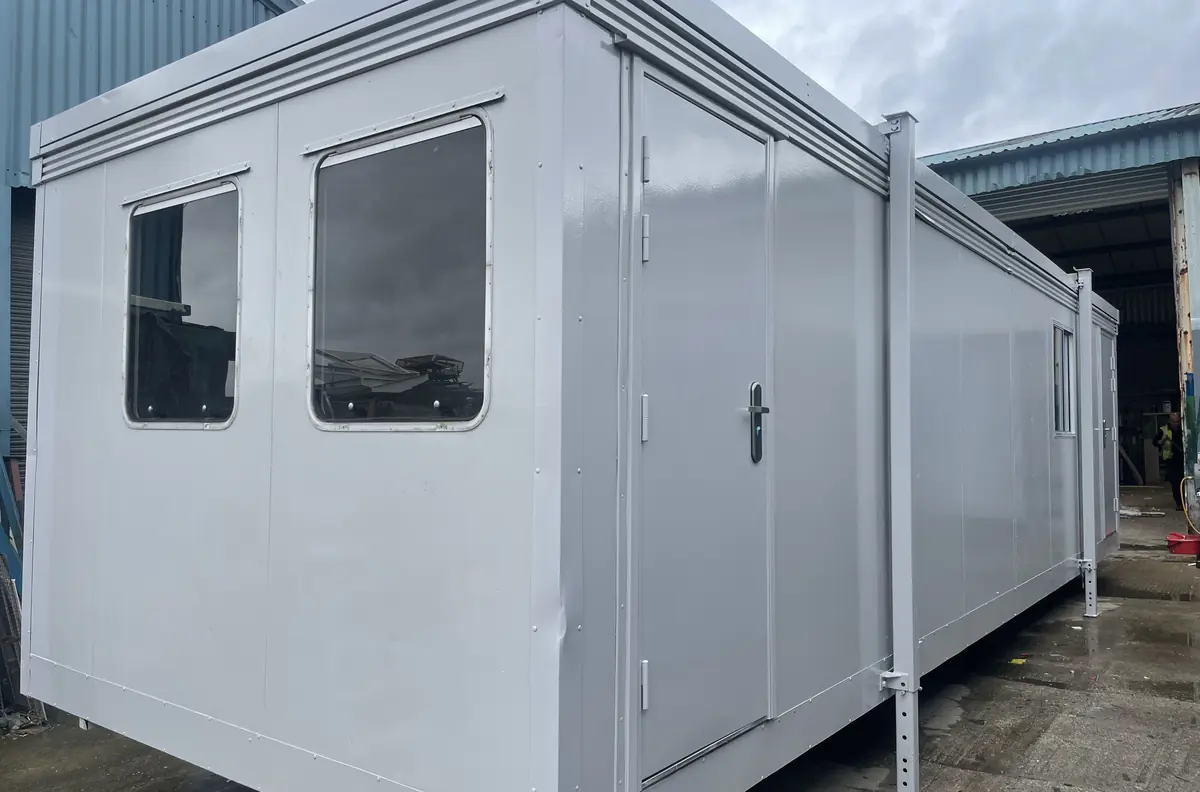
Start on the floor
The floor is where a used cabin gives itself away first. Stand in the doorway, then walk the length of the unit with your weight going through your heels. Anything soft, anything that gives, anything that sounds different underfoot is where water has been getting in, and it has usually been getting in for longer than anybody admits.
Two spots matter more than the rest. The threshold at the door, because that is where boots carry water in and where the seal gives up first. And the strip under each window, because a window that has been weeping quietly through two winters will have wet the boards below it long before a stain appeared. Press with a thumb. If there is a rug or a loose carpet tile in a used cabin, lift it, because often enough it is there for a reason.
A soft patch by the door is not automatically a reason to walk off. It is a reason to know about it and pay accordingly. Boards and linings can be replaced. What you do not want is to discover it in November, after the money has gone.
The roof edge and any ponding
You will rarely get onto the roof, and you should not climb on a structure you do not know. What you can do is get above it — a bank, a step ladder somebody is holding, the back of a pickup. Look for water sitting on it, or the tide mark left by water that has since dried off. A flat roof on a portable unit is not truly flat. It is meant to fall gently towards one edge. If a puddle sits in the middle, the frame has moved or the roof has sagged, and it will keep collecting water for the rest of its life.
Then look at the edges. The join where the roof sheet meets the side is where most leaks start. Lifted mastic, a rust stain running down from a fixing, a corner pushed in by a forklift — all worth noting. On a steel unit, sight along the roof line from one end. A bow in the middle tells you something has sat on it, or in it.
Frame, corners and lifting points
Any unit worth buying has to be liftable, so the corners and the lifting points belong near the top of the list. On an anti-vandal steel unit the lifting eyes sit in the top corners. Look hard at the metal around them rather than at the eye itself. A torn or cracked corner post is serious, and it is the sort of thing that stops a unit ever being moved again. On a jackleg cabin, look at the legs and where they meet the chassis. Bent legs get straightened all the time. A leg that has pulled its mounting is a different conversation.
Stand at one end and sight down the long side. A unit that has spent years on soft ground takes a twist, and that twist shows up in doors and windows that no longer sit square in their openings. Which leads on nicely.
Doors, windows and shutters
Open everything, close everything, lock everything. A door that needs a shoulder is telling you the frame has moved, and adjusting the hinges does not cure a racked unit, it only shifts the problem to the other corner. Windows should open and hold on their stays. Shutters should run without a fight. If they have been left down for three winters they will be stiff, and freeing them off is ordinary work — but a buckled shutter has been forced at some point, and that is worth knowing about.
Check the locks turn with the keys you are actually being handed. It sounds too obvious to write down. It catches people out constantly. Ask how many sets come with the unit, because a cabin with one key and no way of cutting another is a small problem that grows.
The electrics and the paperwork behind them
Cabins are normally wired to 240V with lighting, sockets and usually a heater. What you cannot judge by eye is whether any of it is sound. Get the cover off the consumer unit if you are allowed and see whether the work looks like a job or a bodge. Sockets spurred off with lamp flex, a heater on a circuit never meant to carry it, connections wrapped in a bag — you know it when you see it.
This is the one area where we will be firm about our own stock. Everything that leaves us is fully electrically tested and certified, and the paperwork goes with the unit. That matters most when a cabin is landing on somebody else's site and a manager wants to see something before he lets it be plugged in. Buying privately, ask what testing has been done and ask to see the certificate. A vague answer is not the end of the world, but price in getting it tested yourself.
Damp, condensation and what insulation is actually in there
Black spotting in the top corners, a musty smell, wall lining curling at the edges — that is condensation history rather than proof of a leak. Cabins get condensation because warm damp air meets a cold surface, and a cabin in February with a kettle going and six wet coats in it makes plenty of warm damp air. It is manageable. Water coming through the roof is not.
Insulation is worth asking about directly, because it depends entirely on the age of the unit and how it was specified when it was built. Some units have a fair amount, some have very little, and you cannot tell from the outside. We describe the actual cabin in front of us rather than making a blanket claim about everything standing in the yard. If people are going to be sat in it through a winter, make it part of the decision rather than an afterthought.
Cosmetic against structural
Plenty of what puts buyers off is paint. A used unit that has been on a job for six years will look like it. Scuffed cladding, a faded door, somebody's stickers, a dent in a panel — none of that changes what the cabin does. It should change the price, and it usually does.
| What you find | Usually means | How much it matters |
|---|---|---|
| Dents, scuffs, faded paint | Ordinary site life | Cosmetic, priced in |
| Soft board at the threshold | Long-term water at the door | Repairable, worth knowing |
| Water sitting on the roof | Sagged roof or moved frame | Ongoing, will recur |
| Door that will not shut square | Unit has twisted | Structural, look closer |
| Cracked corner post or lifting eye | Damage from a bad lift | Serious, may not be liftable |
| Untidy consumer unit | Unrecorded alterations | Get it tested before use |
The units we take in are graded on that basis, and it is why we say plainly on what we buy that it is not any cabin in any condition — it depends on what is actually in front of us.
Where to look next
If you are shopping rather than inspecting one particular unit, our current used portable cabins for sale and the anti-vandal steel units are the sensible starting point, and the gallery gives you an idea of the sort of condition we deal in. Tell us the size you want, where it is going and what it is for, and we will tell you what we have and describe it as it actually is. Ring 0330 175 6831 during the week, or send the details through the quote form and we will come back to you.