
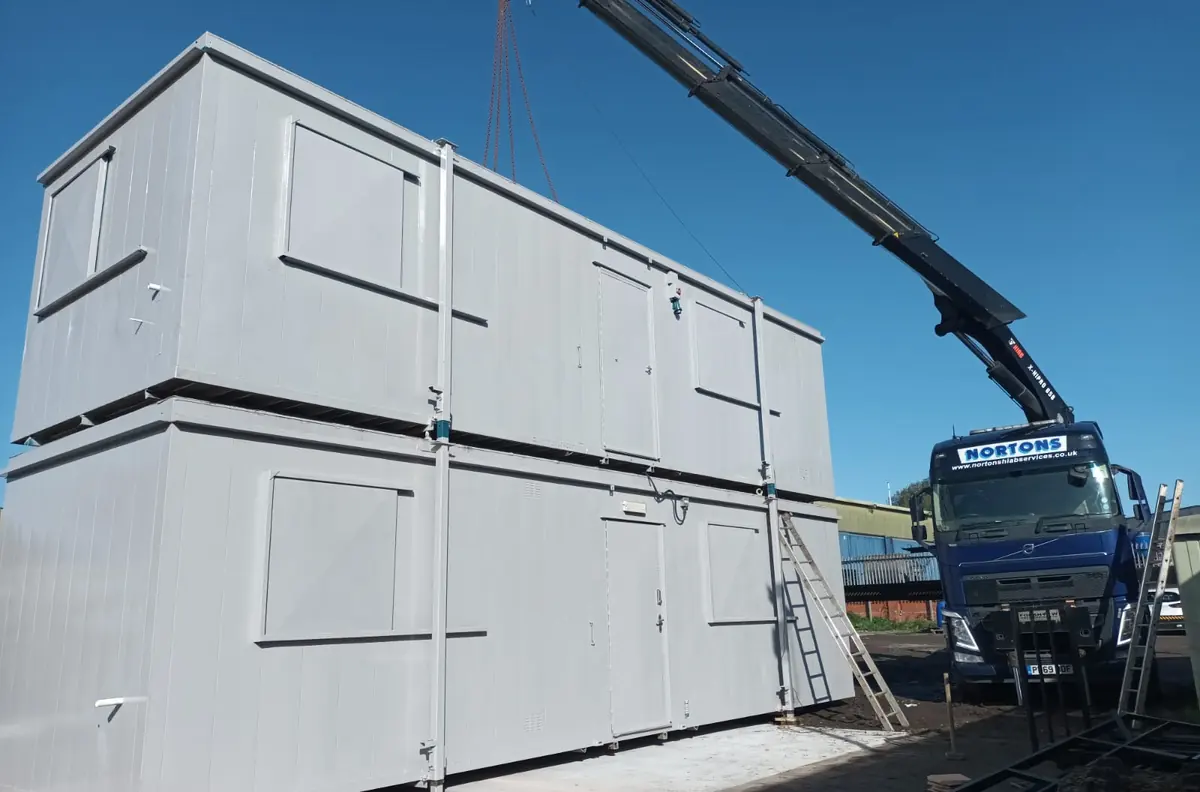
One vehicle, two jobs
Hiab is a manufacturer's name that the trade has turned into a general word, the way people say Hoover. What it means in practice is a hydraulic crane mounted behind the cab of a lorry. The crane folds down onto the vehicle when it is travelling and unfolds when the lorry gets where it is going. Same vehicle carries the unit, same vehicle lifts it off.
That sounds like a small thing. It is not. Without it, moving a cabin is two jobs booked with two firms who have to arrive on the same morning within an hour or so of each other. A flatbed turns up, a mobile crane turns up, and if either is late the other one is standing there doing nothing. Anybody who has organised that once tends to remember it.
Our lorries carry their own crane, so there is no separate crane hire, no second booking and no waiting for somebody else's diary. When we say a unit is delivered and sited, we mean the lorry lifts it off and places it where you want it, rather than leaving it standing at the gate for you to work out.
The bit people get wrong: weight at distance
Every lorry loader has a rating, and people usually hear that rating as a simple weight limit. It is not. The number that matters is how much it can lift at a given radius — that is, how far out from the lorry the load is when it is hanging on the hook.
Reach and capacity work against each other. Close in to the vehicle, the crane will pick up a great deal. Extend the boom out to its full length and the safe load falls away sharply, because the turning force working against the machine grows with every metre. A unit the crane could handle easily at four metres may be well outside what it can do at ten.
So when we ask how far the cabin is from where the lorry can stand, we are not making conversation. That distance is half the calculation. A 20ft cabin sitting fifteen metres inside a yard with no vehicle access is a harder problem than a 32ft unit the lorry can park alongside. The question is never just how heavy it is. It is how heavy it is, at how far away.
Over a wall or a hedge
Lifting over an obstacle is normal work and we do it regularly. A boundary wall, a hedge, a fence line, a low outbuilding roof between the road and the plot — all of these can usually be worked over, and it is one of the main reasons a lorry loader is worth having.
It comes with conditions attached. The boom has to stretch far enough over in the first place. The load has to be inside what the crane will take with the boom out that far, which is a smaller figure than most people assume. And the driver has to have the whole swing in sight, from the moment it leaves the ground to the moment it lands, with no blind section in the middle. That last one is not negotiable. A driver working blind over a wall he cannot see the far side of is a driver guessing, and nobody should be guessing with a steel unit in the air.
Send a photograph from the road looking in, and another from the far side looking back if you can get there. It answers more questions than a paragraph of description.
Over a building, never
We do not lift over buildings. Not over an empty one, not over an occupied one, not over a lock-up, not over the corner of a house at a weekend when nobody is in. It is a flat no with no exceptions and no case-by-case discussion, and any firm that tells you otherwise is one you should think carefully about.
If the only route to the standing position is over a roof, the answer is to find another route or another standing position. Sometimes that means taking a fence panel out, sometimes it means the unit goes somewhere else on the plot. It is worth working that out in advance rather than on the morning.
Overheads, ground and outriggers
Three things stop a lift on the day more often than anything else.
What is above. Power lines, telephone cables, tree branches, a canopy, the underside of a bridge on the approach. A boom that has to go up before it goes out needs headroom, and cables in particular need to be treated as a hard stop rather than something to be judged by eye. Walk the route looking upwards, which is not how anybody naturally walks a site.
What is underneath. Soft ground is the quiet one. A verge that looks fine in August is a different surface after a wet fortnight, and a made-up surface over an old fill can move under load. Drain covers, inspection chambers, basements and cellars under a yard surface all matter, because the weight the lorry puts down when it is lifting is not spread evenly across the vehicle.
The outriggers. The legs that come out from the sides of the lorry to stabilise it need room and they need firm footing. Extended out on pads, they take a large share of the load, and they cannot be put down on something that will sink or crack. Room to deploy them is part of it too — a lorry squeezed into a lane with a car parked either side may not be able to get its legs out on the side it needs.
What that means for the money
Everything above feeds into what the moving side of the job costs: the distance, the access at both ends, whether the lift is simple or awkward, and whether there are several units in one place or one on its own. None of that can be worked out from a postcode on its own, which is why we ask where a lorry can stand before we say anything about cost.
One thing we will not do is tell you how long a job takes, and we will not promise to tell you in advance either. Too much of it depends on what is found on the day. Anybody quoting you a duration down the phone for a site they have not seen is telling you what you want to hear.
Sending us what we need
Photographs from the gate looking in, a note of the gate width, anything overhead, what the surface is, and where the unit sits in relation to where a lorry could stand. That is genuinely most of it. There is more detail on the Hiab collection page, and if the unit needs taking off a live site the cabin removal page covers how that usually runs.
We run across mainland Great Britain — England, Scotland and Wales — and you can check the detail on areas we cover. To get moving, use the quote form or ring 0330 175 6831 and describe the site to us. If the lift will not work, we will say so early rather than send a lorry to find out.