
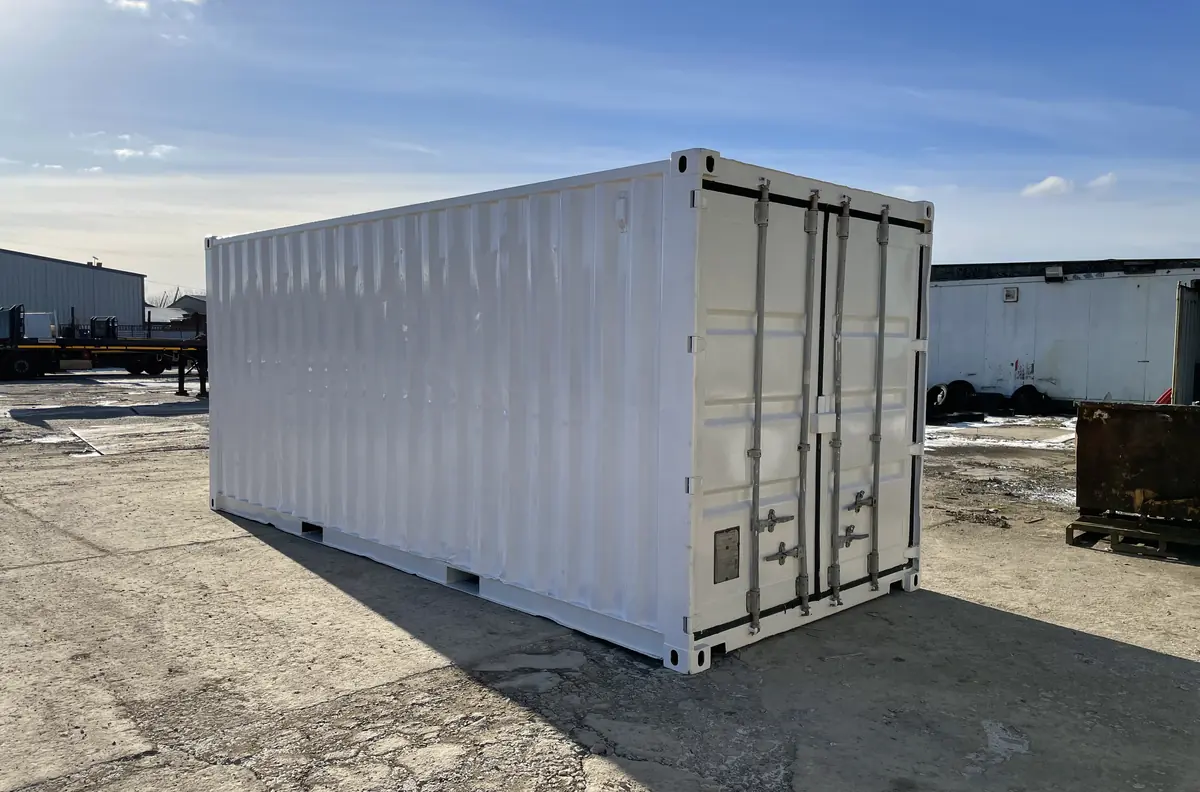
Every size, from an 8ft box to a 40ft
Ask three people what size container they need and you will get three answers in feet, none of which describes the space they were imagining. Containers are named by their external length. That is how they are stacked, shipped and priced, and it is not the number that decides whether your racking fits.
These are the sizes we buy and sell, with the width and height kept out of the table because they barely change between them.
| Size | Roughly | Where it tends to suit |
|---|---|---|
| 8ft and 10ft | Short boxes, around 2.4m and 3m long | Tight yards, gardens, tool and plant stores, anywhere a lorry has to thread in |
| 20ft | Around 6m long | The workhorse. Enough for most site storage and easy to place |
| 24ft | A shortened 40ft | When 20 is not quite enough and 40 will not go in |
| 32ft | A shortened 40ft | Long storage runs on a yard that cannot take a full 40 |
| 40ft | Around 12.2m long | Volume storage where there is room to deliver and stand it |
| High cube | Same footprint, roughly a foot taller inside | Tall stock, pallets stacked high, anything on a rack |
Width and height are close to standard across the board. Nominal 8ft wide, 8ft 6in tall for a standard box and 9ft 6in for a high cube. The high cube is the one people forget to ask about, and it is the difference between a pallet stack going in and not.
Why shortened containers exist
A 24ft or a 32ft is not made that length at the factory. It is a 40ft that has had a section taken out of the middle and the end welded back on. That is worth knowing for two reasons.
First, it explains why they exist at all. A 40ft container needs a lot of room to deliver, a lot of room to swing, and a clear standing area longer than most small yards can offer. Plenty of sites want the storage but simply cannot take the box. Shortening one solves it without going back to two 20s and two sets of doors.
Second, it tells you where to look on a used one. There is a joint, and the quality of the work varies enormously depending on who did it. Look along the roof line and down the side for the line of the weld, check it is straight, check the corrugations line up, and look at the seams inside for daylight and for rust running down from the join. Done properly it is a sound box. Done badly it is a box that leaks in one very specific place.
Shortened units also lose the standard corner-casting spacing that lifting equipment expects, so how a particular one gets handled depends on the unit. With our own Hiab lorries the lorry lifts the container on and off itself, which takes a separate crane booking out of the job, but the driver still needs to see the whole arc and get the machine within reach.
Internal against external, and where people get caught
The name is the outside. The steel, the corner posts and the corrugations all take their share.
The inside is always smaller than the name suggests, on width and on height, and a shortened box varies more than a standard one. If a few inches decide it, measure the box in front of you.
The door opening is smaller again, and it is the measurement that catches people out most often. The frame eats into both the width and the height at the end, so a load that fits the inside of the container comfortably can still refuse to go through the doorway. If you are storing something bulky, measure the doorway, not the box.
We would rather you did that than take delivery of something that does not work.
Doors, floor and what to check on a used one
A container is a simple thing, which means there is not much to inspect and no excuse for skipping any of it.
Start with the doors. Open them fully and shut them again. The cam handles should drop into their keepers without a shoulder behind them, the hinges should not be seized, and the rubber seals should be soft rather than flattened and cracked. Doors are the part that decides whether a box stays dry, and a container that has stood twisted on soft ground for two years will fight you on them.
Then get inside and shut yourself in for a moment. Daylight through a seam or a roof panel shows up instantly and shows up nowhere else. Look up. The roof takes the worst of the weather, it is the part nobody ever checks, and dents that hold standing water rust from the top down.
The floor is boarded, and it takes a beating. Look for soft patches, look for anything that has been driven through by a forklift, and look at what the boards are like at the door end where the water and the grit get in. Give the underside a look if the box is stood on blocks. Surface rust on a container is ordinary and means very little. Rust you can push a screwdriver through is a different conversation.
Finally, think about condensation before you fill it. A sealed steel box with damp goods in it will sweat, and the water runs down the walls onto whatever is stacked against them. Vents help, standing it clear of the ground helps, and not storing something soaking wet helps most of all.
Conversions
Containers get cut about for all sorts of uses. Personnel doors, roller shutters, windows, part-storage and part-workspace, side openings, and boxes split into sections. Conversions come through the yard regularly and we buy and sell them, but they are judged one at a time. A neat conversion by somebody who knew what they were doing is worth having. A doorway cut through a side wall with no frame put back is a weakened box, and we will say so.
Working out which size fits your yard
Measure the standing area, then measure the route in. It is common enough for a 40ft to fit the space and be impossible to get to, and that is the point at which a shortened 32 starts making sense.
Tell us the postcode, what the access is like and what you want to keep in it, and we will tell you honestly what will and will not work. Have a look at the containers we have for sale, or if you have one standing empty at your end see selling a container to us and what we buy. Send photographs through the quote form or ring 0330 175 6831.