
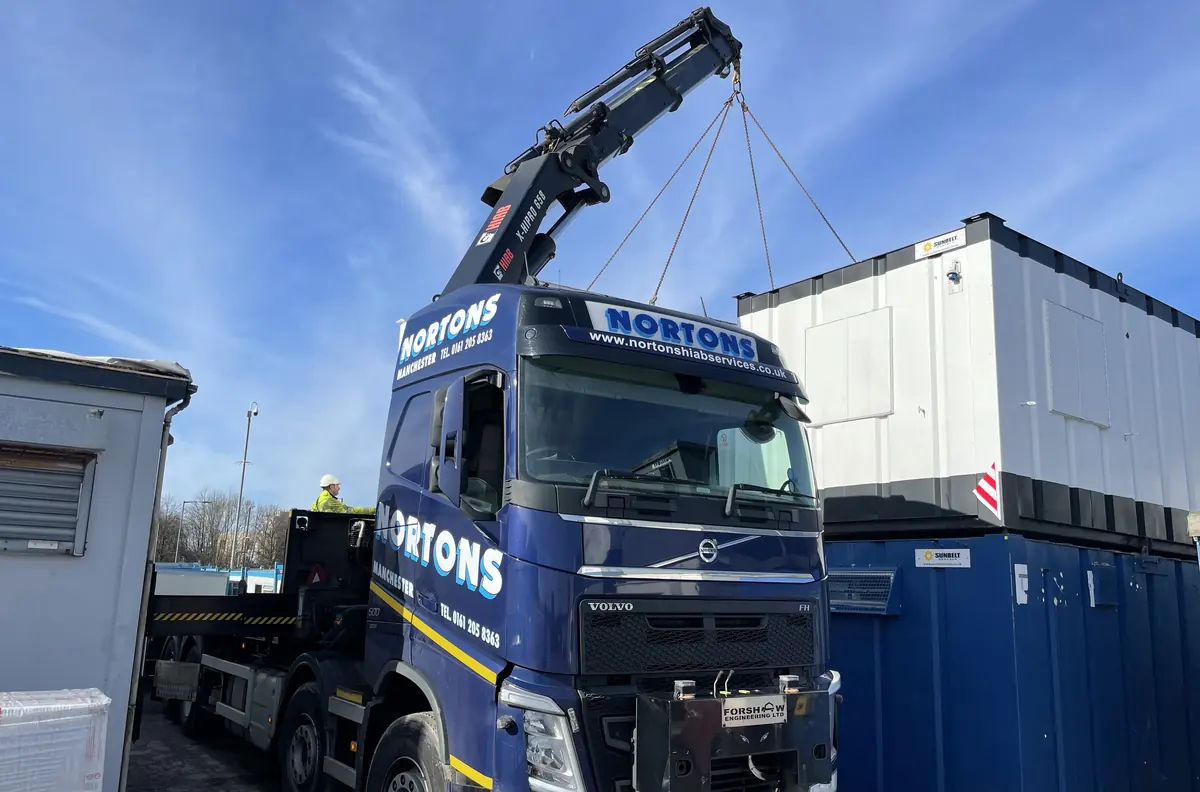
The call usually comes too late
It happens often enough that the pattern is familiar. A job is finishing, the fencing contractor is booked, somebody has finally worked out that four cabins and two containers are still standing in the compound, and the phone goes on a Thursday afternoon with a fortnight left on the site. Sometimes less.
We can often still do something. But a seller with two weeks and a hard end date has given away every bit of room they had to negotiate. There is no room to wait for the right buyer, no room to move a lift to a day that suits the route, and no room to say no to a figure. Meanwhile whoever is on the other end of the call knows exactly how much time you have, because you told them in the first sentence.
None of that is a trick played on contractors by dealers. It is just what happens when a decision that was always coming gets made at the last possible moment.
What ringing early actually buys you
Start the conversation while the job still has weeks in it and several things change at once.
If your collection date can flex, tell us, because it sometimes lets us fit the job to a run we are already making. We will not promise that in advance. Our coverage across England, Scotland and Wales is wide, but the arithmetic of a long empty leg does not change just because we are willing to make it.
You also get time to fix cheap things. A door that will not shut, a shutter seized half down, a window with a pane out — small jobs while your joiner is still on site, and awkward ones once everybody has gone. A unit that opens and closes properly reads as a unit that has been looked after.
And you get to make a decision rather than accept one. Some units are worth selling, some are worth moving to the next job, and some are honestly finished. Working out which is which takes a look and a conversation, not a scramble.
Have this ready before you ring
Almost every delay in pricing a job comes from missing information rather than disagreement about value. Get this together first and the whole thing goes faster.
- How many units, and what each one is: cabin, site office, jackleg, anti-vandal steel, welfare, toilet block, container.
- The size of each. Cabins run 10, 12, 16, 20, 24 and 32ft, and "a big one" tells us nothing.
- Photographs. All four sides of each unit, the inside from both ends, the floor at the door and under the windows, and the consumer unit.
- The postcode, and the name of the site if the postcode drops a driver in the wrong field.
- Access notes: gate width, the surface underfoot, whether a lorry can turn round in there, what is overhead, and what is standing between the lorry and the unit.
- A date after which the site is not yours any more, said honestly.
One photograph taken from the gate looking in is worth a paragraph of description. Our page on Hiab collection explains why access matters as much as the unit does, and it is the part sellers most often skip over.
Multiples in one place are worth more than the same units scattered
Four cabins standing together on one compound and four cabins spread across four counties are not the same proposition, even if the units are identical. One booking, one journey, one set of access questions, one visit. That efficiency shows up in what the whole lot is worth to us.
So if your business is winding down two or three jobs across a few months, it is worth asking whether the units can end up in the same place first, or whether the timing can be lined up. Sometimes it cannot. When it can, it is usually the biggest single lever a seller has.
The same goes for mixed lots. We buy singles happily enough, but we also take a cabin, a container and a toilet block together, and a mixed group off one compound is a straightforward job rather than an odd one.
Two figures, not one
This catches people out, so we say it early in every conversation. The cabin carries one figure. Getting it moved carries its own, because the two answer to entirely different things.
What the unit is worth comes down to what it is, what size it is, and what condition it is in. What the haulage costs comes down to how far it is, what the access is like, and how straightforward the lift will be at both ends. A sound 20ft office on a clear yard half an hour away and the same office down a farm track four hours away are worth the same as cabins and cost very different amounts to move.
Anyone who gives you a single number without asking about access is either padding it heavily or is going to revise it when the driver turns up and sees the site. Our guide to what a used cabin is worth goes through the things that lift a figure and the things that kill it.
What we will not tell you
We will not tell you how long a collection takes, and we will not promise to tell you in advance either. It depends on the ground, the access, the lift, the traffic and what somebody has parked where it should not be. Anybody giving you a duration down the phone before they have seen the site is guessing, and a guess made to keep you happy is worse than no answer.
What we will do is be straight about what we are coming for and what we need to get to it. If the access turns out to be nothing like the description, that gets dealt with honestly on the day rather than pretended about beforehand.
Start the conversation before the last fortnight
If you know a job finishes in the spring, ring in the winter. Nothing is committed by an early conversation, and the worst outcome is that you know what your units are worth several weeks before you need to.
Tell us the sizes, the postcode, how many there are and how the lorry gets in, and we will price it. Send it through the sell page or the quote form with photographs, or ring 0330 175 6831. We are on the phone Monday to Friday 6am to 6pm and Saturday morning, and enquiries that land outside those hours get answered.