
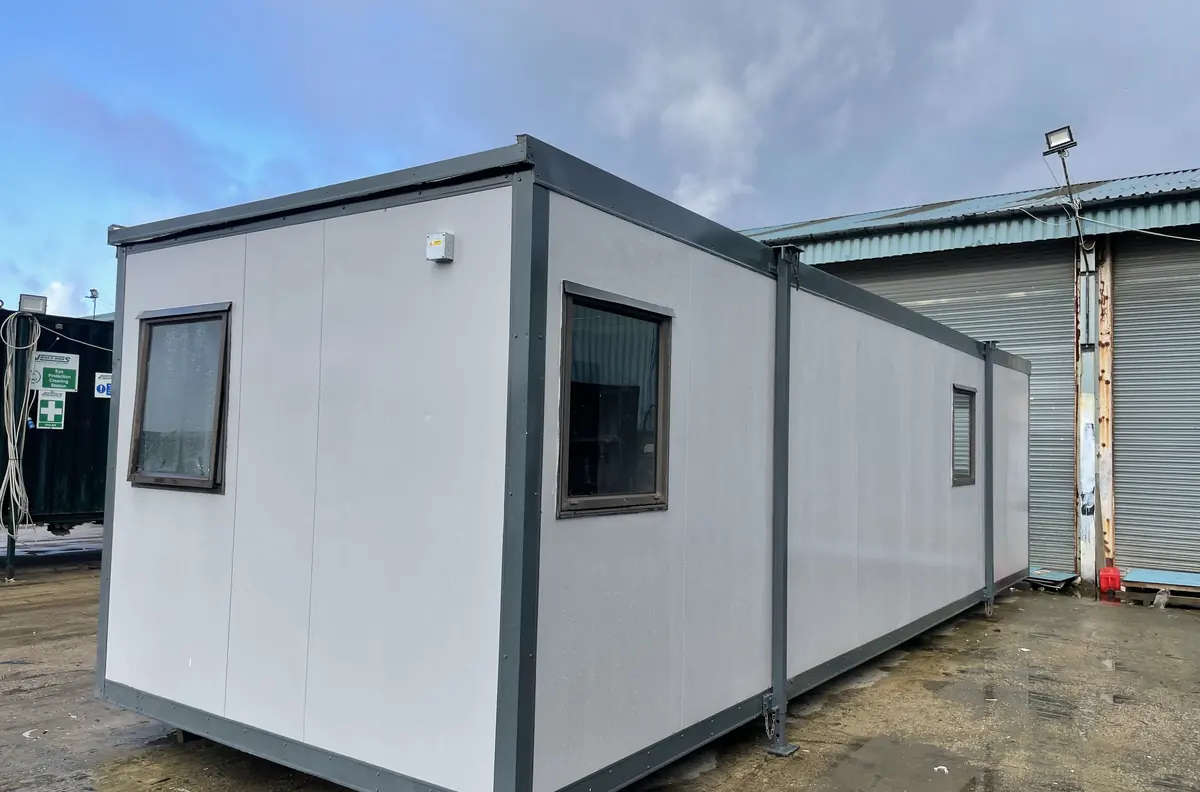
Two different answers to the same problem
Both are portable cabins. Both do the same basic job of putting a dry room on a bit of ground that did not have one. Where they part company is in how they are built and, more to the point, in what happens to them when everybody goes home on Friday.
A jackleg cabin sits on adjustable legs at the corners, which is where the name comes from. You wind them down, you level the unit, and it stands clear of the ground. The construction is lighter — a steel chassis with a lighter body on top of it. An anti-vandal unit is essentially a steel box: steel skin, steel doors, steel shutters over the windows, and considerably more weight to it.
Where a jackleg cabin earns its place
Lighter means easier to move, and easier to move means cheaper to move. On a job where units come and go, or where the compound gets rearranged every few months, that adds up. The legs mean you can level it on ground that is not perfectly flat without laying a proper base first, which is a genuine time saver when the pad has not been poured yet and the job starts Monday.
As an office it is usually the nicer place to sit. Larger windows, more natural light, and a body that warms up faster on a cold morning than a steel box does. For a short-term site office on a site that has a hoarding, a gate and somebody in the hut at night, a jackleg cabin is often the sensible buy.
The weakness is the same as the strength. Lighter construction is easier to get into. A determined person with a bar can be through a jackleg door in less time than it takes to describe, and once they are in there is nothing much stopping them. On a site that empties at four on a Friday and stays empty until Monday, that is the thing to weigh.
Where anti-vandal steel earns its place
Steel units are heavier, colder to start with on a winter morning, and darker inside because the windows are smaller and sit behind shutters. Nobody buys one for the ambience. They buy one because it takes a weekend alone considerably better than the alternative.
Shutters are the main event. Wound down and locked, they take the windows out of the equation entirely, and a unit with nothing visible through a window is a unit with less reason for anybody to try. The doors are heavier and the locks are mounted into steel rather than into a lighter frame. None of that makes a unit impossible to get into — anything can be got into given enough time and enough noise — but it moves your cabin down the list of the easiest thing on the street.
They also stack and travel better, and they take knocks that would mark a lighter unit permanently. On a groundworks job where the cabin is going to be brushed past by a telehandler twice a week, steel wins on durability alone.
Side by side
| Jackleg cabin | Anti-vandal steel unit | |
|---|---|---|
| Construction | Steel chassis, lighter body | Steel skin throughout |
| Weight | Lighter | Heavier |
| Levelling | Adjustable legs at the corners | Needs a level, firm base |
| Windows | Larger, more light | Smaller, behind shutters |
| Security when empty | The weak point | The reason to buy one |
| Moving it again | Quicker and cheaper | Heavier, so more to lift |
| Best suited to | Short-term offices, supervised or hoarded sites | Sites left empty, exposed locations, longer stays |
The question to actually ask yourself
Not which is better. Neither is better. The useful question is what the site looks like at two in the morning on a Sunday. If it is behind a hoarding on a live commercial job with a gateman, a jackleg cabin will serve you well and cost less to shift when you are finished. If it is a plot on the edge of a village with a post-and-wire fence and a footpath running past it, buy the steel and stop thinking about it.
The other half of it is how long the unit is staying. A cabin that will be lifted four times in two years wants to be light. A cabin going in for the duration of a three-year build can afford to be heavy, and will look after itself better while it is there.
Where one does both jobs
Plenty of small sites end up running a steel unit as the office because it is the only unit on the plot and it has to be secure. That works. Put a decent heater in it, keep it ventilated, and accept that it will never be as pleasant as a jackleg cabin with a proper window. If there are two units, the usual split is a jackleg office and a steel unit for tools and stores — which is a sensible arrangement, because it puts the security where the value actually is.
What we check before a steel unit leaves us
Refurbishment is a word the trade uses loosely, so here is exactly what we mean by it. Before an anti-vandal unit goes out, the shutters and windows are freed off and made to work, the doors and locks are checked, and the electrics are tested and certified with the paperwork supplied.
How much other work a particular unit has had varies. Some come in needing very little. Some have had a good deal done to them. We are not going to tell you every steel unit in the yard has been stripped and rebuilt, because it would not be true. What we will do is describe the actual unit you are asking about as it actually is, including the bits that are not perfect. Stock is mostly refurbished; the electrical testing and certification is the part we will state flatly for everything that leaves.
Deciding, and what to send us
If you have narrowed it down, the current used jackleg cabins and used anti-vandal cabins pages are the place to look, and used site cabins covers the wider range if you are still open-minded about it. If you have not narrowed it down, tell us the size, the postcode, how long the unit is staying and what the site does overnight, and we will tell you which way we would go.
Send it through the quote form or ring 0330 175 6831. We sell these and we buy them back, so if the job changes and the unit is no longer wanted, the conversation carries on rather than stopping.