
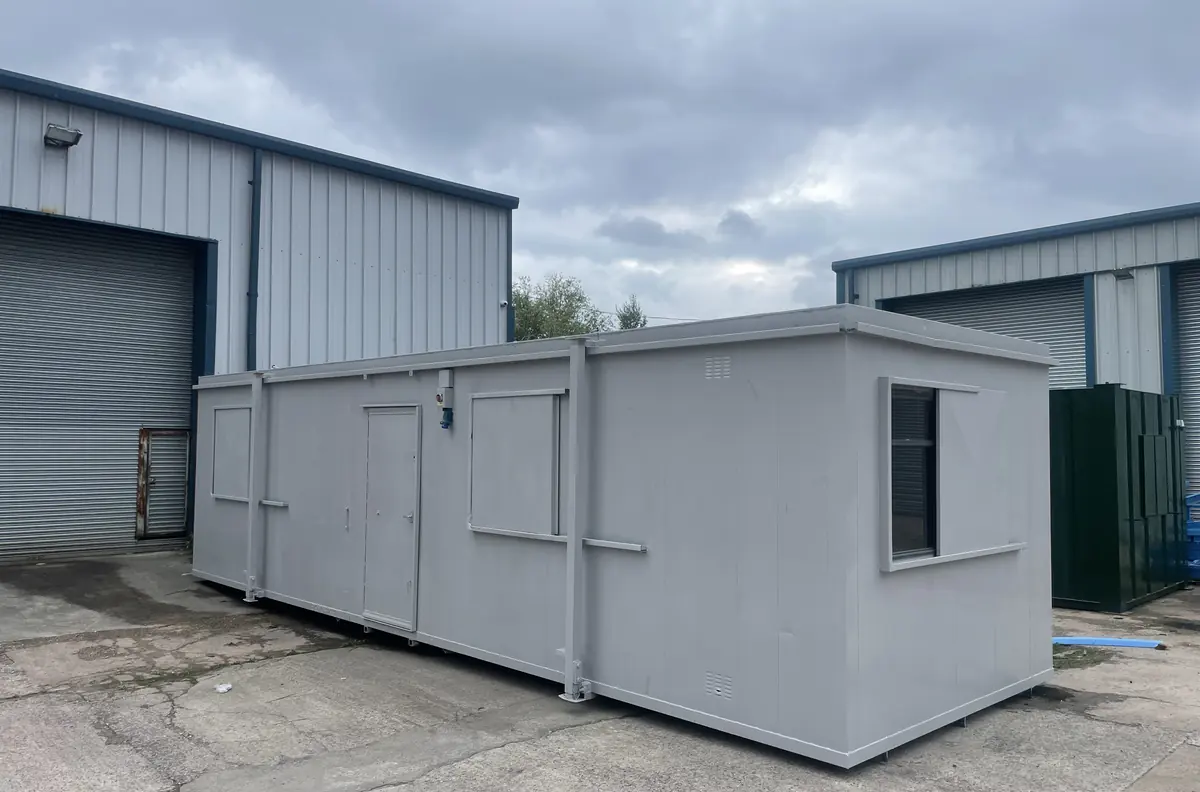
Why nobody can price it blind
Two 20ft cabins of the same age can be worth very different money. One has a dry floor, working electrics and stands on hardstanding two minutes from a wide gate. The other has had water sat in it since last autumn and is wedged behind a container in a yard the lorry cannot turn in. Same unit on paper. Not the same job, and not the same figure.
So when we ask for photographs, the postcode and a few lines about access, it is not a stalling tactic. It is the only way to give a number that still means something when the lorry turns up. Guessing high and revising on the day is the trade's oldest bad habit and we would rather not take part in it.
The two figures, and why they stay separate
There is the money for the cabin, and there is the haulage. We quote them as two figures, always. The cabin is worth what it is worth wherever it is standing. The haulage depends on how far we are coming, what the access is like when we get there and how the lift works out.
Keeping them apart is more useful to you than rolling them together. If you are weighing up whether to sell a unit or move it to your next job, you need to see what the steel is worth separately from what the journey costs. Bundle the two and you cannot tell which half of the number you are arguing with. It also means that if you have three units in one yard rather than one, you can see immediately why the arithmetic improves — the haulage does not treble.
What lifts the figure
Size does most of the work at the start. Cabins run at 10, 12, 16, 20, 24 and 32ft, and the larger sizes hold their value better because there are fewer of them about and they are harder to replace. Beyond that, it comes down to condition and to how easy the unit is to get hold of.
- An intact floor. This is the single biggest one. A cabin with a sound floor is a cabin somebody can use next week. A cabin with a soft floor is a repair job before it is anything else.
- Working electrics. Wired to 240V, lighting and sockets in place, a heater that runs. Everything that leaves our yard is fully electrically tested and certified with paperwork supplied, so a unit that arrives with sound wiring already in it costs us less to get to that point.
- A straightforward lift. Firm ground for the outriggers, no cables overhead, room for the lorry to set up on the side it needs.
- A clean access route. A gate wide enough, a surface that will take a loaded eight-wheeler, and somewhere to turn without a twenty-point shuffle.
- Multiples in one place. Three or four units on one site are worth more to us collectively than the same four scattered across three counties, and the figure reflects that.
- Doors, windows and shutters that work. Freeing off a stiff shutter is routine. A door that no longer shuts square is not.
What flattens it
The list runs the other way just as clearly, and being told about these things early does not lower our offer so much as stop it being withdrawn later.
A rotten floor is the obvious one. Water sat in a unit for a season does far more than wet the boards — it gets into the linings, it corrodes fixings, and by the time it dries out the smell tends to stay. A unit that has been left open, or left with a leaking roof through a winter, is often the same cabin that was worth decent money eighteen months earlier.
Then there is access. A unit that has been boxed in by later building work is a genuine problem. It happens more than people think: the cabin goes in first, the extension goes up around it, and now there is no route out that does not involve dismantling something. If a crane cannot reach it and our lorry cannot reach it, the cabin's condition stops being the deciding factor. The same goes for a unit standing on ground that will not carry the weight of the lorry, or one buried at the back of a compound behind everything else that has to move first.
Structural damage matters more than cosmetic damage by a long way. A torn corner post or a damaged lifting point can take a cabin out of the running entirely, because a unit that cannot be lifted safely is a unit nobody can do anything with. And there are units we will not take on any terms — anything structurally gone, or anything with a contamination history nobody can account for. We are straight about that on what we buy rather than turning up and having the conversation in your yard.
What haulage actually responds to
Distance is the obvious component, and we cover mainland Great Britain — England, Scotland and Wales — so distance can be considerable. It is not the only thing. Access changes the haulage figure as much as mileage does, because a job where the lorry parks up, sets its legs and lifts is a different job from one where three vehicles have to be moved and a fence panel taken out first.
Our own Hiab does the lifting, which is the part that keeps the number sensible. The crane is on the lorry, so the same vehicle carries the unit and lifts it on and off. No separate crane hire, no second contractor to book, nobody waiting on site for somebody else to arrive. There is more on how that works on the Hiab collection page, and the practical limits are worth reading if your unit sits somewhere awkward.
Getting a figure that holds
What we need from you is not much. Sizes and how many. Photographs of all four sides, the inside from both ends, the floor at the door, and the route in from the gate. The postcode. A sentence about what is standing between the lorry and the cabin. If you know something is wrong with it, say so — it almost never costs as much as people fear, and it stops the figure being rewritten on the day.
The valuation guide goes through the same ground in more detail, and if you have made your mind up already, sell a cabin to us is the direct route. You can also just ring 0330 175 6831, Monday to Friday from 6am, and describe it down the phone. We buy singles and we buy multiples, and we will tell you plainly if the answer is no.